Category

Aquariums

August 8, 2026

Traveling abroad to visit Forests Underwater, Takashi Amano’s masterpiece

A quick look at the massive ocean aquarium at Oceanário de Lisboa

I traveled from the United States to Lisbon for work in May 2026, then stayed through the weekend with one destination firmly marked on my itinerary: Forests Underwater, Takashi Amano’s immense Nature Aquarium at the Oceanário de Lisboa.

After more than a decade of growth, pruning, maintenance, and slow biological change, the living installation was nearing the end of its run. The Oceanário had announced that the exhibit would close in 2026, bringing an eleven-year experiment in aquascaping to an end. I had followed Amano’s work for years, so finding myself in Lisbon with only months remaining felt like particularly good timing. I wasn’t going to fly home without seeing it.

A wall with illuminated text displaying motivational phrases in both Portuguese and English, encouraging people to stop, listen, and appreciate nature while living simply.
Visitors observing aquatic life in a large aquarium with lush underwater vegetation.
A vibrant underwater scene featuring a variety of aquatic plants, including colorful lilies and lush greenery, with a sandy bottom and wooden driftwood arranged artistically.

Walking into the gallery, the room is almost completely dark. Then the illuminated water comes into view, stretching across the space in a sweeping, 40-meter-long composition.

The aquarium contains around 160,000 liters of freshwater. Its construction required approximately 12 tons of sand, 25 tons of volcanic rock, and 78 tree trunks, all carefully arranged to create valleys, slopes, clearings, and dense woodland. It remains the largest Nature Aquarium ever created.

Visitors exploring an aquarium exhibit with large windows showcasing underwater scenery.
Interior view of an aquarium with two large glass tanks filled with plants and aquatic life, illuminated in a dark room.
Underwater scene featuring lush green aquatic plants and various small fish swimming amidst sandy bottom

The scale becomes clearer as you begin walking alongside it. One section opens into pale sand and open water. Another rises into thick banks of moss, ferns, and stem plants. Roots reach outward from the planted slopes, creating sheltered spaces where fish gather before drifting back into the open.

It feels remarkably mature. Wood has darkened and softened with age. Moss pours over branches and stone. Plants reach the surface and emerge into the air in places. After more than a decade of careful cultivation, the landscape has the wonderful unruliness of something that has been allowed to grow into itself.

Aquarium landscape featuring various aquatic plants, rocks, and sand substrate, depicted under water with vibrant greenery and a tranquil atmosphere.
An underwater scene featuring various fish swimming among lush aquatic plants and colorful vegetation in an aquarium.

By the time I visited in May 2026, the aquarium was still described as holding more than 10,000 tropical freshwater fish from around 40 species, surrounded by 46 species of aquatic plants.

Altum angelfish move through the taller sections with their long fins suspended beneath them. Pearl gouramis linger closer to the surface and among the roots. A multitude of Tetras stream through the open water while Otocinclus, Siamese algae eaters, and Amano shrimp work their way through the planted landscape.

Underwater scene featuring lush aquatic plants, submerged driftwood, and a clear blue backdrop
Underwater scene featuring lush aquatic plants, including large green leaves and vibrant red foliage, with a clear surface reflecting light.

The vegetation is equally varied. Large masses of aquatic ferns and moss cover branches and stone, while Rotala and Ludwigia create broad sweeps of green, bronze, and red. Lotus leaves reach toward the surface. Plants grow from submerged valleys toward the light, while others cling directly to the enormous pieces of wood that form the skeleton of the landscape.

Takashi Amano and the Nature Aquarium

Takashi Amano was an aquarist, photographer, designer, and one of the most influential figures in modern planted aquariums. Through his company Aqua Design Amano, better known as ADA, he popularized the Nature Aquarium approach around the world.

A display featuring Takashi Amano, a renowned nature photographer and expert in freshwater aquarium design, highlighting his philosophy on the beauty of nature.

Amano spent years photographing forests and wild environments in Japan and abroad, including expeditions to the Amazon, Borneo, and West Africa. Those experiences informed the way he approached aquariums. Rocks, wood, plants, negative space, light, and movement could be composed to evoke the structure and atmosphere of a much larger landscape.

You can see that philosophy everywhere in Forests Underwater.

Fish disappear behind planted ridges and emerge farther down the aquarium. Branches create paths through vegetation. Open stretches of sand give the denser sections room to breathe. Light reaches through the surface and catches leaves at different depths. Even areas of open water contribute to the composition.

As someone who spends a lot of time exploring forests, photographing wetlands, and building small ecosystems at home, I found myself studying those transitions as much as the individual plants.

A vibrant underwater scene featuring lush aquatic plants and sandy substrate, with a clear water surface reflecting light.
Underwater scene displaying vibrant aquatic plants and a sandy bottom in a clear aquarium setting.

Sand disappears beneath roots. Moss gradually gives way to taller vegetation. Dense shadows open into clear water. From a few feet away, a planted section can look like a single green mass. Move closer and it separates into dozens of textures, leaves, branches, and tiny places for fish to disappear.

I walked around the exhibit several times. Each pass revealed something I had missed five minutes earlier.

Underwater scene featuring lush aquatic plants, driftwood, and sandy floor, with sunlight filtering through the water's surface.
Vibrant underwater scene featuring various types of aquatic plants, including green ferns and red foliage, along with natural wood elements.

Forests Underwater became Amano’s largest and final major work. He led an international team during its creation, working with ADA staff, the Oceanário, and volunteer aquascapers from several European countries. The exhibition opened in April 2015.

Takashi Amano died only a few months later, in August 2015, which adds another layer to seeing the aquarium near the end of its life.

A vibrant aquarium scene featuring various aquatic plants, driftwood, and fish swimming in clear water.
A tranquil aquarium scene featuring various fish swimming in clear water, with sandy substrate and aquatic plants along the bottom.

Amano created something designed to live. Plants grew, fish populations changed, wood aged underwater, and thousands of hours of human care kept the landscape moving along the path he originally envisioned.

I left the gallery with hundreds of photographs, although the experience stubbornly resists being contained by a single frame. The length of the aquarium, the darkness of the room, the sound of water, and the gradual accumulation of tiny details all reward moving slowly along the glass.

Beyond the Underwater Forest

Forests Underwater was the reason I extended my stay, but it occupies only one corner of the Oceanário de Lisboa.

At the center of the building is an enormous saltwater aquarium containing roughly five million liters of seawater. The habitat stretches through the heart of the Oceanário and can be viewed from multiple floors, so you repeatedly encounter the same body of water from entirely different perspectives.

View of an aquarium through a dark passage, featuring blue water, coral, and various fish swimming in the background.

Sharks cruise through the deeper water while rays glide overhead. Huge schools of fish continually reorganize themselves into shifting shapes. Around another corner, the same animals might appear twenty feet below where you last saw them.

The architecture makes the central aquarium feel considerably larger than it already is. Rather than standing in front of one giant viewing window, you gradually discover it as you move through the building. Each opening frames another small piece of the habitat.

Underwater view of a vibrant aquarium with various fish swimming among rocks and coral formations.

The Oceanário has become particularly well known for keeping these enormous and wonderfully peculiar animals. Watching one slowly emerge from the blue is an experience. They possess the general appearance of a fish whose assembly instructions were lost halfway through construction.

I also explored the Oceanário’s small botanical garden and planted spaces, filled with tropical vegetation, ferns, and dense greenery.

A wooden path winding through a lush tropical garden filled with dense foliage and plants, with two people walking in the background.

After spending so much of the day looking at Amano’s interpretation of forests beneath the water, ending the visit among living plants above the waterline felt fitting.

The Oceanário deserves several hours on its own. I went for Takashi Amano and Forests Underwater, then spent the better part of a day wandering through the rest of the aquarium, which is equally as amazing.

September 23, 2021

Low-tech bookshelf nano planted aquariums

While sometimes more difficult to maintain than larger tanks, due to more volatile water parameters, I love how nano tanks look — especially on the bookshelf in my office. In late June 2021, I re-scaped two of my nano tanks. Here are some photos 3 months later.

Currently, the only livestock these tank house is snails. I’ll most likely keep it that way.

Nano low-tech planted aquariums on a bookshelf

Top tank: Low-tech molten glass over wood (<1 gallon)

Nano low-tech planted shaped glass aquarium on a bookshelf

Details

  • Tank — Hand blown molten glass on wood. This is a higher quality one from West Elm that was a gift. It has very thick glass (over 1cm thick!) I would NOT recommend using the cheaper versions of this for holding water, like those found on Amazon
  • Light — Nicrew clamp light. Perfect brightness for nano tanks
  • Hardscape — Locally sourced granite. What a pain to get into this bowl!
  • Plants — Anubias nana petite & microcarpaea minima (carpet)
  • Livestock — Bladder snails
  • Other — Walstad method with an air pump for circulation (black tube is not co2). Weekly 90% water change
Nano low-tech planted shaped glass aquarium on a bookshelf

Bottom tank: Low-tech 3.5 gallon long

Nano low-tech aquarium on a bookshelf

Details

  • Tank — 3.5 gallon Seapora “Betta Breeder” (I would never put a betta in anything this small, but it’s perfect for snails and shrimp)
  • Light — Fluval Aquasky Nano light
  • Hardscape — Seiryu stone
  • Plants — Dwarf hair grass (carpet), Anubias nana, Anubias nana petite, some stray riccia fluitans keep showing up
  • Livestock — Bladder snails!
  • Other — Low-tech: Small aqueon hang filter and an air pump for extra surface disruption (black tube is not co2). Liquid ferts once a week. Weekly 90% water change

Here’s an outline of the light settings for the Fluval above the 3.5 gallon tank. With the snails, it’s nearly algae free with this light intensity

Fluval Aquasky Nano settings

September 19, 2021

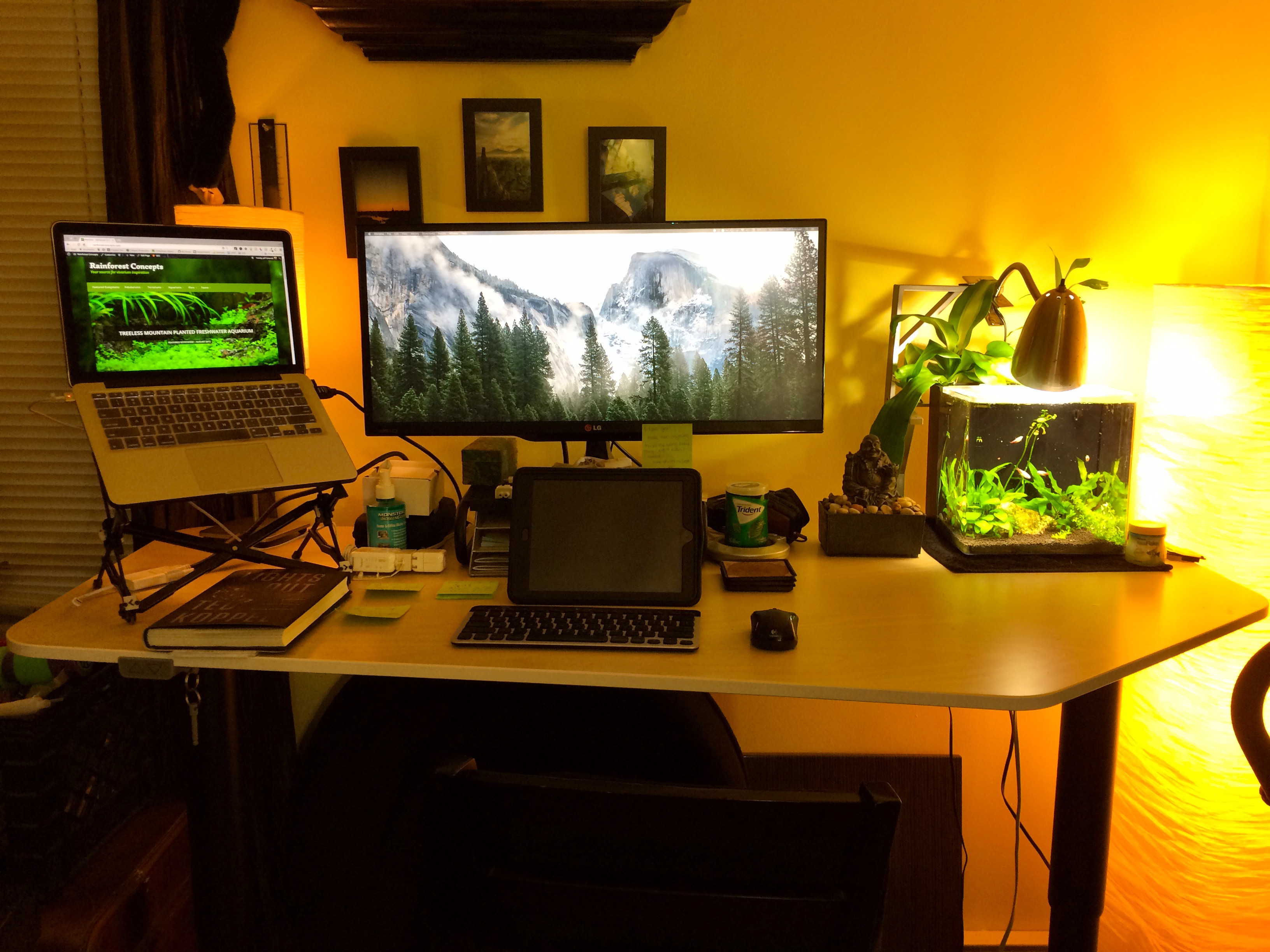
Shallow desktop planted tank

I constructed a really fun shallow freshwater planted aquascape that sits on my desk next to my work station. Details after the photo.

Monte Carlo carpet in an ADA cube garden 60-F

Hardware:

  • ADA cube garden 60-F tank
  • basic co2 system
  • UNS canister filter system
  • Nicrew light

Plants & livestock:

  • Monte carlo (carpet)
  • Anubias nana
  • Mini coin Bucephalandra
  • bucephalandra purple blue
  • 5x purple rasbora fish
  • 6x hastatus corydoras (the cutest fish in the world)

December 24, 2019

The smallest nano planted aquarium

a tiny nano planted aquarium

I suppose this could technically be considered a nano riparium, but this nano planted aquarium is the smallest little aquarium I’ve made. Sand in the front, and eco complete substrate in the back for the plants. It houses pond snails, blue leopard ramshorn snails, copepods, and detritus worms. It’s a tiny complete ecosystem.

November 1, 2019

How to: Create a Jarrarium on a budget

What is a Jarrarium?

A Jarrarium is a nano-sized aquarium that’s made with a glass jar or vase. Often, Jarrariums are freshwater, containing plants, snails, and even shrimp. Due to their small size, you should never put fish in a jarrarium (not even Betta fish), because they’re too small to fit fish comfortably. I’ve even seen some small saltwater jarrariums that house tiny coral, but they’re more rare and difficult to maintain.

nano freshwater planted aquarium in a vase
A nano freshwater planted aquarium in a vase, otherwise known as a jarrarium.

It’s important to note that the smaller the container in which you build your nano planted aquarium, the more difficult it will be to maintain balanced water parameters. I highly recommend learning the basics of freshwater planted tanks and building a larger tank (such as a 10 US gallon) to practice before building jarrariums, otherwise you may get frustrated with how quickly they can crash.

A Blue leopard ramshorn snail can be seen on the volcanic rock


In this jarrarium tutorial, I’ll walk you through a recent Jarrarium I made using a cheap glass vase, sand, rock, substrate, plants, and snails.


How-to

Container + Stand for Jarrariums

Decorative glass vases are perfect for jarrariums

For this particular nano tank build I used a decorative vase I found on clearance for $10. It’s 10 inches tall and has a diameter of 6 inches. Check your local craft or department stores for the best prices. Don’t forget to find some coupons online!

The stand for this is actually a cutting board. Finished bamboo cutting boards are great for nano tank stands. In the gallery below you’ll see that I use them for several tiny planted jarrariums on my bookshelf.

Jarrarium Lighting

For a tank this size, I generally don’t go too crazy with lighting otherwise algae can overwhelm your tank quickly. For this vase, I used an older desk lamp with a really funky 4-Pin Quad Tube CFL Light Bulb 6500k. You can also find special nano tank lights at your local fish store if you have a few extra dollars to spend.

The most important thing to pay attention to if you’re buying regular old lightbulbs from a department store is the color rating and lumens. If you can find household LED bulbs rated at 6500k color temp (“full spectrum” daylight) and 1500 lumens, you’re in business.

Substrate & Stone for Jarrariums

In this jarrarium I got fancy with two different types of substrate:

  • Decorative fine white gravel – not good for plants unless you’re liquid dosing fertilizer (not recommended in super tiny tanks)
  • Eco-complete substrate specifically made for planted tanks
The eco-complete substrate is hidden behind the rocks.

You can see in the photo above that I hid the dark eco-complete substrate for the plants behind the volcanic rock and used the white fine gravel in the front for better contrast. I also took my time with placement of the rock. I spent a good 45 minutes playing with the rock shapes before I found the composition I was happy with. Composition is everything.

Experimenting with rock placement in my jarrarium

I first bought a larger chunk of rock from my local fish store, and then broke it down with a hammer and a chisel.

Important: When putting rocks in small containers, be cognizant of weight. This volcanic rock is super lightweight since it’s filled with millions of air pockets. Stone from your local riverbed or lake will probably be MUCH heavier. If too much is placed in a small glass container, it could break. Check your local fish store for different types of decorative aquarium rock that’s suited for aquarium use.

Jarrarium Plants

Tissue cultured java fern, crested java fern, and green ozelot

Plants make the aquascape. In aquascaping, plants are actually the focus point, as opposed to the animal life. In this jarrarium, I chose taller plants that are typically used as background plants in larger freshwater planted aquariums, because of the shape of the vase.

I also tend to purchase “tissue cultured” plants that are grown in a lab. They’re always pest and parasite free. Unfortunately, when you buy plants at fish stores there are often times hitchhikers that can cause problems if you don’t sterilize the plants properly. Look up “aquarium hydras” on youtube and you’ll see what I mean.

Filtration, Aeration, and Co2

Here’s where things can get tricky based on experience level with nano planted aquariums. If you have a lot of plants stocked in your tiny tank and minimal animal life, you generally don’t need a bio/mechanical filter. but if you’re just starting out and aren’t familiar with how nitrates, nitrite, amonia, etc. all cycle in aquariums, I’d recommend buying the smallest filter you can (filters made for Betta Fish are generally the way to go).

I started this jarrarium build with a super small filter made for nano tanks, but it ended up occupying too much space. So, I made my own rudimentary filter. I took some filter mess and jammed an air stone in it. The mesh provides a place for the bacteria necessary for tank cycling to live. The movement of the air bubbles rising through the mess drives water flow through the mesh so a little bit of proper filtration can occur.

Although the aeration isn’t completely necessary because I have a lot of plants, I’m using it for water movement in this tank. The bubbles keep the water from becoming stagnant or bio film from covering the surface of the jarrarium.

During photosynthesis, plants intake carbon dioxide which helps them grow. Some folks inject co2 through a diffused to keep their plants lush. In tiny aquariums like this it’s often difficult to supplement co2 properly with that method, but you can use other methods like liquid carbon dosoing. The blue liquid in the tiny glass device you see in the video above is a co2 indicator. When it’s blue it means the co2 is low. When green it’s just right, and when it’s yellow you have too much, which can harm animals in your tank. Once this tank cycles a bit more, with some small liquid dosing, this indicator will turn green!

Creatures (Fauna) for Jarrariums

A baby blue leopard ramshorn snail cleans the leaf of an ozelot sword

Now, you should never put fish in a jarrarium (not even Betta fish), because they’re too small to fit fish comfortably. Fish will quickly become stressed and die. Also, keep in mind that the smaller the container in which the aquarium lives in, the easier it is for chemicals to become imbalanced. If you had a jarrarium with 3 neon tetras, and one died while you were sleeping, the ammonia spike would most certainly kill the other two as well.

At the time of this post / video I have about 6 snails. 3 Blue Leopard Ramshorn snails, and some pond snails. A lot of people think snails are pests, but I keep them in every tank I have – terrariums (different type of snails), paludariums, and aquariums. Aquatic snails such as ramshorn, mystery snails, and pond snails keep algae away. Pond snails have even been known to eat Hydra, which are pests that sometimes eat baby fish and shrimp.

In the future, I’ll most likely introduce some cherry shrimp, because they’re amazing little creatures and also keep algae at bay!

Before you add the water to your Jarrarium

Photo of the jarrarium before water was added

Take your time to place everything. The substrate, rocks, and plants all work together to form the composition of an Aquascape. In the photo above, I’ve planted everything in the vase before adding any water. Make sure you spray your plants as you’re working though, if the leaves dry out they’ll die.

Finished jarrarium aquascape

What I love most about nano planted aquariums in jars and vases, it’s that you can build so many of them with limited space! In my office I already have 3 jarrariums and a nano shrimp tank. They’re fairly cheap build and they’re great conversation pieces.

Let me know what you think in the comments and be sure to subscribe for more!


Gallery

Plant & Fauna list

  • Riccia Fluitans (floating) ($5)
  • Green Ozelot Sword ($5-10)
  • Crested Java Fern ($5-10)
  • Java Fern ($5-10)
  • Blue Leopard Ramshorn Snails ($2 each.)
  • Neo Cardinia shrimp such as blue velvet or cherry work well for larger Jarrariums (not added yet). ($5 each)

Materials Needed

  • Vase or Jar (<$10). This one was from Target
  • Substrate (Up to $30)
  • Lighting ($10)
  • Tiny filter or simple air stone (<$10)
  • Plants, snails, or shrimp
  • Stone ($10-15 for this much). Check out your local fish store
  • Patience – in order to construct a proper jarrarium that’s going to last, take your time with research and material collection. Once I had all the necessary materials for this nano planted aquarium, I spent about 3 hours constructing it.

August 21, 2016

125 Gallon Freshwater Planted Dutch Tank

Tank Details:

SeaClear 125g tall 60″ x 18″ x 24″ w/ extra large top openings
2x 60″ BML Dutch 6300k @ 90 degree beam angle
GLA GRO-1 Co2 system w/ 18″ rex griggs reactor
Eheim Pro II 2028 w/Biohome mini media
Marineland C360 w/Biohome mini media
Odyssea 18w UV Sterilizer
300w Eheim Jager heater
Custom EI dosing w/ Osmocote+ root tabs
Water changes – every Sunday
Photo period – Lights on at 10:30am, off at 10:30pm (12hr on/off)
Co2 sched – On at 9:00am, off at 10pm (13hr on 11hr off)
Temp – 79
GH – 6
KH – 4
PH – 6.7
Nitrites -null
nitrates – 10-20ppm
__________________
Flora:
eleocharis belem
AR Mini
ammania senegalensis
Blyxa japonica
Pogostemon erectus
Pogostemon helferi
eriocaulon parkeri
eriocaulon feather duster
tonina lotus blossom
rotala ramosoir sunset
Ludwigia sp. red
rotala H’ra
rotala mini butterfly
rotala magenta (macrandra narrow leaf)
rotala indica (ammania sp. bonsai)
rotala wallichii
rotala macrandra green
limnophila indica
limnophila aromatica
limnophila guinea broad-leaf
trithuria sp. blood vomit
cryptocoryne lutea
Lloydiella Green
syngonanthus sp. belem
Ludwigia inclinata var. pantanal
fissidens fontanus
Fauna:
(20) Cardinal Tetra
(150) Black Bar Endler (mix of fry, juvie, & adult)
(14) Harlequin Rasbora
(8) otocinclus
(6) Corydoras sterbai
(2) Corydoras julii
(9) Ember Tetra
(3) Celestial Pearl Danio
(3) Siamese Algae Eater
(100+) Painted Fire Red shrimp
(1) Bamboo Shrimp
(1) CPO (Cambarellus patzcuarensis)
(10) Assorted Nerites
(5) Assassin snails